

Why your workplace should have a defibrillator: an Australian guide

Short answer: a cardiac arrest can happen to anyone at work, and the first few minutes decide whether they survive. An AED on site lets the people already there deliver a shock before the ambulance arrives. Workplace safety regulators tell employers to consider one where workers could be electrocuted, an ambulance could be delayed or large numbers of the public come through, and South Australia requires them in many public buildings from 1 January 2026.
An automated external defibrillator (AED) is a portable device that reads the heart’s rhythm and, if the rhythm is shockable, delivers a shock to reset it. It talks the user through every step, so anyone can use one, trained or not.

Why the first five minutes decide it
More than 32,000 people in Australia have a cardiac arrest each year, and only about 10% survive when it happens outside hospital. When CPR starts straight away and an AED is used within 3–5 minutes, survival can climb to 60–70% (Heart Foundation).
An ambulance often can’t get there in that time. In Victoria, the average response to a Code 1 emergency was 15 minutes 28 seconds in January to March 2026 (Ambulance Victoria). The defibrillator that gives someone the best chance is the one already on site.

Victoria shows what happens when AEDs are close by. Paramedics attended a record 7,550 cardiac arrests in 2024–25, and 63% of patients defibrillated by a bystander survived. A record 152 patients received a shock from a public AED (Victorian Government, March 2026).

What Australian workplace safety guidance says
Cardiac arrest can happen to anyone, anywhere, including at work. Here’s what Australia’s workplace safety regulators say about AEDs.
- First aid in the workplace Code of Practice: employers “should consider providing an AED” where there’s a risk to workers of electrocution, a likely delay in ambulance arrival, or large numbers of members of the public (SafeWork NSW).
- WorkSafe WA: “Workplaces should be provided with AEDs”, especially where those same risks exist (Bulletin No. 11).
- WorkSafe Victoria: AEDs should be in “well-known, visible and accessible locations”, should not be locked, and recommends registering the AED’s location with Ambulance Victoria (WorkSafe Victoria).
- South Australia: from 1 January 2026, listed public buildings and facilities must have a registered AED, including buildings of 600 m² or more open to the public, pools, sporting venues, schools, aged care and places of worship (SA Health). Read our SA AED law explainer.

If your site has people on it, whether staff, contractors or visitors, it has the risk. As WorkSafe WA puts it, “defibrillation is the only way to restore a heart with a fatal heart rhythm back to normal.”
This guide is general information, not legal advice.
What makes a good workplace defibrillator?
The best defibrillator for an Australian workplace is the one a frightened, untrained person can use correctly. Look for:
- Voice prompts loud enough for a warehouse floor or a busy foyer
- CPR coaching on rate, depth and hand placement
- Rhythm analysis that keeps pauses in chest compressions short
- A child setting that doesn’t need a second set of pads
- A dust and water rating that suits your site
- A long warranty and long-life pads and battery, so it’s cheap to keep ready
- The option to monitor it remotely if you look after more than one site
Why the LIFEPAK CR2 is a strong choice for workplaces
Aero supplies a range of AEDs, and the right one depends on your site, your people and how many units you need. The LIFEPAK CR2 is a great option for most workplaces, because it’s built around the person who has never used one. Here’s why.


- It’s heard in noisy places. ClearVoice turns the prompts up on a warehouse floor or in a busy foyer.
- It covers children too. Child Mode drops to paediatric energy (50, 75, 90 J by default) using the same pads.
- It has energy in reserve. Shocks escalate to 360 J for adults (200, 300, 360 J by default).
- It’s built for real sites. IP55 dust and water rating, 2.0 kg, and it works from 0 to 50°C.
- It’s cheap to keep ready. An 8-year warranty, a battery and QUIK-STEP pads that each last up to 4 years, and pads that peel straight off the base.
- Wi-Fi and 4G models go further. cprINSIGHT checks the heart rhythm while compressions continue, which reduces pauses in CPR, and the next shock charges during CPR. These models also report their readiness to LIFELINKcentral.
| Model | Shock delivery | Readiness monitoring | Best for |
|---|---|---|---|
| LIFEPAK CR2 Essential | Semi-automatic or fully automatic | Daily self-test, status shown on the device | Single sites, offices, small business |
| LIFEPAK CR2 Wi-Fi or 4G | Semi-automatic or fully automatic, depending on the model | Reports status to LIFELINKcentral AED Program Manager | Multi-site businesses, councils, fleets |
See the full LIFEPAK range and specifications. Aero supplies other AEDs for different sites and budgets too, and we’ll look at where each one fits in upcoming guides.
Shop the LIFEPAK CR2 Essential
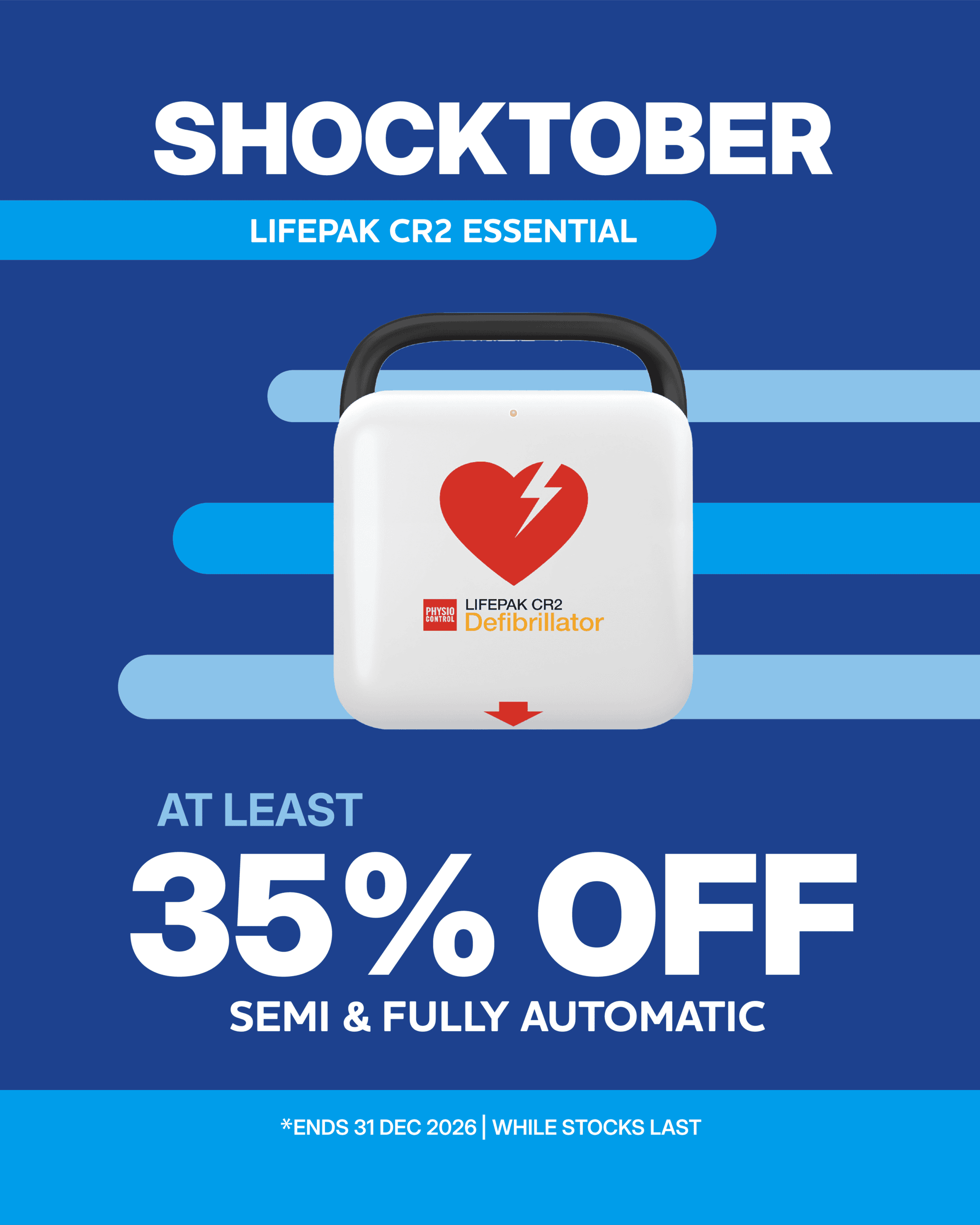
The LIFEPAK CR2 Essential is an automated external defibrillator for use on people in sudden cardiac arrest. Both models are at least 35% off* until 31 December 2026 or while stocks last. Add one to your quote on the product page and an Aero reseller near you will send you a quote.

LIFEPAK CR2 Essential Semi-Automatic Defibrillator
Code: SUB-CR-2E
At least 35% off*
Until 31 December 2026 or while stocks last
- The rescuer presses the shock button when prompted
- ClearVoice and Child Mode
- 8-year warranty
LIFEPAK CR2 Essential Fully-Automatic Defibrillator
Code: SUB-CR-2E-A
At least 35% off*
Until 31 December 2026 or while stocks last
- Delivers the shock itself, with no button for the rescuer to press
- ClearVoice and Child Mode
- 8-year warranty
*At least 35% off Aero Healthcare’s standard LIFEPAK CR2 Essential price, semi-automatic and fully automatic. Ends 31 December 2026 or while stocks last. Excludes LIFEPAK CR2 Wi-Fi and 4G models.
Need remote readiness monitoring? The LIFEPAK CR2 also comes with Wi-Fi (semi-automatic, fully automatic) or 4G.
Keep it ready: replacement pads, replacement battery, cabinets, signage and the CR2 trainer.
Always read the label and follow the directions for use.
Semi-automatic or fully automatic?
A semi-automatic AED tells you to press the shock button. A fully automatic AED delivers the shock itself, with no button to press. Fully automatic takes the hardest decision away from a rescuer who’s never done this, which suits public areas and sites with few trained first aiders. Semi-automatic suits teams with trained first aiders who want control. Both give the same CPR coaching. Compare the semi-automatic and fully automatic CR2 Essential.

Where should a defibrillator go in a workplace?
Somewhere everyone walks past: visible, signed, unlocked and out of extreme heat and cold. The Code of Practice asks for an AED that is “clearly visible, accessible and not exposed to extreme temperatures”, clearly signed and maintained to the manufacturer’s specifications.

- Mount it on the main route, not inside an office that gets locked
- Put a sign near it and at the entrance (required for listed public buildings in SA)
- Use a cabinet if it’s outdoors, in a warehouse or anywhere dust and knocks are a risk
- Keep it close to higher-risk areas: workshops, plant, kitchens
- Register it on your state or territory AED register (see below)

Our rule of thumb: someone should be able to fetch it and get back to the patient inside three minutes. On a big site, that may mean more than one.
Registering your AED
For most workplaces, registering an AED is voluntary but recommended. The exception is South Australia, where AEDs in listed public buildings and facilities must be on the SA AED Register within two weeks of installation. In South Australia, Triple Zero (000) call-takers use the register to direct callers to the nearest AED, and Ambulance Victoria shares registered AEDs with Triple Zero call-takers. There’s no national register: the Heart of the Nation National AED Register has closed, so register with your state or territory.
| State or territory | Where to register |
|---|---|
| NSW | NSW Ambulance, via GoodSAM |
| VIC | Ambulance Victoria, Register My AED (GoodSAM) |
| QLD | Queensland Ambulance Service AED registration |
| SA | SA Ambulance AED Register (GoodSAM) |
| WA and ACT | St John WA First Responder |
| TAS | Tasmanian Department of Health |
| NT | St John NT |
Registers listed by the Heart Foundation.
How much does a defibrillator cost to own?
Price the whole life, not the box. The real cost of a workplace AED is the device, plus replacement pads and battery, a cabinet, signage and CPR training for your first aiders. A long warranty and long-life consumables bring the cost per year down. The CR2 has an 8-year warranty, and its pads and battery each last up to 4 years.
AED maintenance checklist
- Check the status indicator every week, and give one person the job
- Log pad and battery expiry dates and replace them before they lapse
- Replace the pads after every use
- Keep the cabinet and sign clear of boxes, plants and furniture
- Keep your AED register entry up to date if the AED moves or its access hours change (in SA, within two weeks)
- Refresh CPR training every year, as the Code of Practice recommends
At least 35% off* until 31 December 2026
Get a quote on the LIFEPAK CR2 Essential
Choose semi-automatic or fully automatic, add it to your quote on the product page, and an Aero reseller near you will be in touch.
Not sure which one? Tell us about your site and we’ll help. Aero Healthcare supplies the LIFEPAK CR2 in Australia through its reseller network. *Offer terms are under the banner above.
Workplace defibrillator FAQs
Should my workplace have a defibrillator?
Yes. A cardiac arrest can happen to anyone at work, and survival depends on a shock in the first few minutes, often before an ambulance arrives. Workplace safety regulators tell employers to consider an AED where workers could be electrocuted, an ambulance could be delayed or large numbers of the public are present, and South Australia requires them in many public buildings from 1 January 2026.
Do you need training to use a defibrillator?
No. AEDs are designed for untrained people and give spoken, step-by-step instructions. WorkSafe Victoria says you don’t need specialised AED training to use one. First aid training that covers CPR and AED use still helps, and the Code of Practice recommends a CPR refresher every year.
Can an AED shock someone who doesn’t need it?
It’s designed not to. An AED analyses the heart’s rhythm and only advises or delivers a shock when it detects a shockable rhythm. If no shock is needed, it tells you to keep doing CPR.
Can a workplace defibrillator be used on a child?
Yes, if it has a child setting or paediatric pads. On the LIFEPAK CR2, for example, Child Mode lowers the energy (50, 75 and 90 J by default) and switches to child CPR guidance, using the same pads.
Semi-automatic or fully automatic: which is better for a workplace?
Fully automatic suits public areas and sites with few trained first aiders, because the device delivers the shock itself. Semi-automatic suits trained teams who want to press the button. On the LIFEPAK CR2 Wi-Fi and 4G models with cprINSIGHT, semi-automatic is faster to shock: under 7 seconds versus under 13 seconds after CPR.
Where should a defibrillator be placed in a workplace?
On the main route, visible, signed, unlocked and out of extreme temperatures, close to higher-risk areas. As a rule of thumb, someone should be able to fetch it and get back to the patient within about three minutes, so large sites may need more than one.
How long do defibrillator pads and batteries last?
It depends on the model. On the LIFEPAK CR2, the battery and QUIK-STEP pads each last up to 4 years, and pads must be replaced after every use. Log the expiry dates and check the status indicator weekly.
Do I need to register my workplace AED?
For most workplaces, registration is voluntary but recommended. Registering it on your state or territory AED register helps emergency services and volunteer responders find it. The exception is South Australia, where AEDs in listed public buildings and facilities must be on the SA AED Register within two weeks of installation.
- Heart Foundation: Cardiac arrest
- Victorian Government: Victoria leads the nation in cardiac survival (11 March 2026)
- SA Health: AED requirements for public buildings and facilities
- SafeWork NSW: First aid in the workplace Code of Practice
- WorkSafe WA: Health and Safety Bulletin No. 11
- WorkSafe Victoria: Use of an AED in the workplace
- Ambulance Victoria: Ambulance response, Quarter 3 2025/26
- Heart Foundation: Heart of the Nation and state AED registers
 Introducing the NEW Mini Modulator - perfectly sized for taking on your next adventure!